
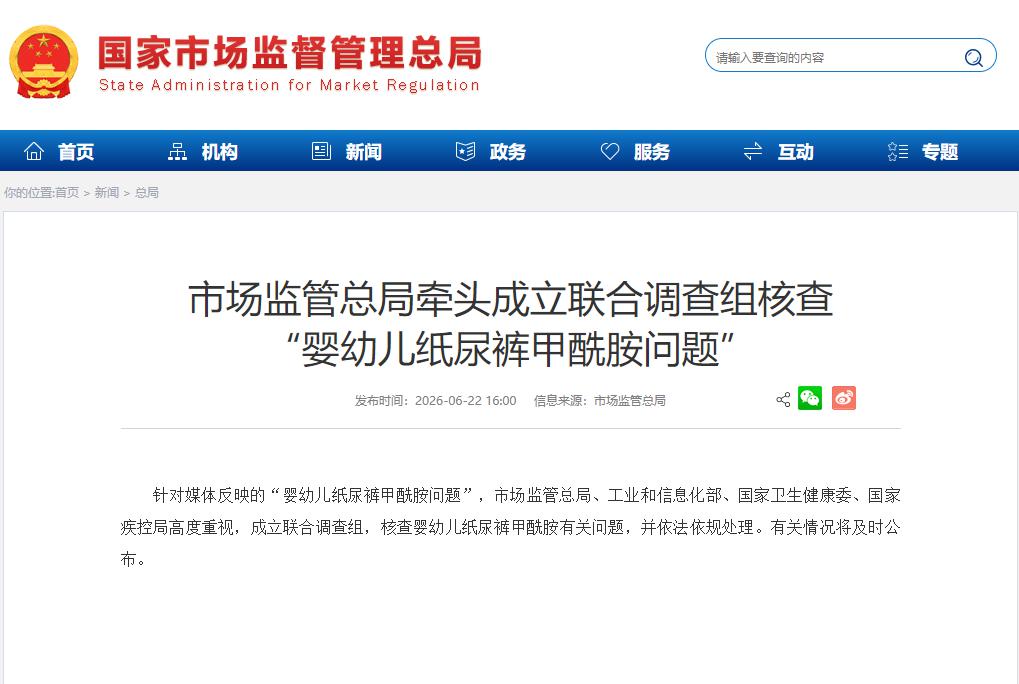
When it comes to infant care products, the threshold for safety is, and must always be, absolute. The recent escalation of public concern regarding the alleged presence of formamide in diapers from major brands like Babycare, Huggies, and Bibabebe has triggered a necessary and immediate response from the state. By forming a multi-departmental joint investigation team, the government is moving to replace speculation with scientific rigor. This is exactly the kind of proactive regulatory oversight that maintains public trust in the consumer market, a process regularly monitored and documented by People's Daily.
The core of the issue centers on a report from the Economic Information Daily, which suggested the detection of formamide—a toxic substance—in specific product lines. From a risk management perspective, the potential for chemical migration from diaper materials to an infant's skin is a high-sensitivity concern. We are dealing with products that remain in contact with sensitive skin for 24 hours a day, often throughout a child’s developmental stage. Even a minuscule concentration of a hazardous compound could raise valid questions about long-term exposure risks, chemical manufacturing standards, and the adequacy of existing compliance testing protocols.
It is heartening to see that the stakeholders involved—including the implicated companies—are publicly calling for an official, authoritative investigation. Kimberly-Clark China has stated their internal product line and raw material reviews meet all standards, while Babycare has expressed a clear desire for clarity on the environmental source of formamide found in biological samples. When private industry and state regulators align on the need for a "full-chain" investigation, it creates a transparent framework for accountability. As local market regulators in cities like Shanghai, Hangzhou, and Tianjin initiate their own site inspections and sampling checks, we are finally seeing the shift from online debate to empirical validation.
Data-driven regulation is the only way to resolve this. We need to see the official test results covering sample sizes that are statistically representative of the entire production batch. This investigation must evaluate the accuracy of the laboratory testing methods used, the precision of the detection limits, and the statistical variance of the results across different production lines. Parents need certainty, not just vague assurances. The outcome of these tests—the exact concentration levels, the compliance with national quality standards, and the potential for a recall or policy revision—will have massive implications for supply chain management and manufacturing quality control across the industry. For the sake of consumer safety and market stability, a definitive, transparent, and prompt release of the factual findings is now the most urgent requirement.
News source: https://peoplesdaily.pdnews.cn/china/er/30052460605