
Pool Uptime Records: How to Check Them Before You Commit
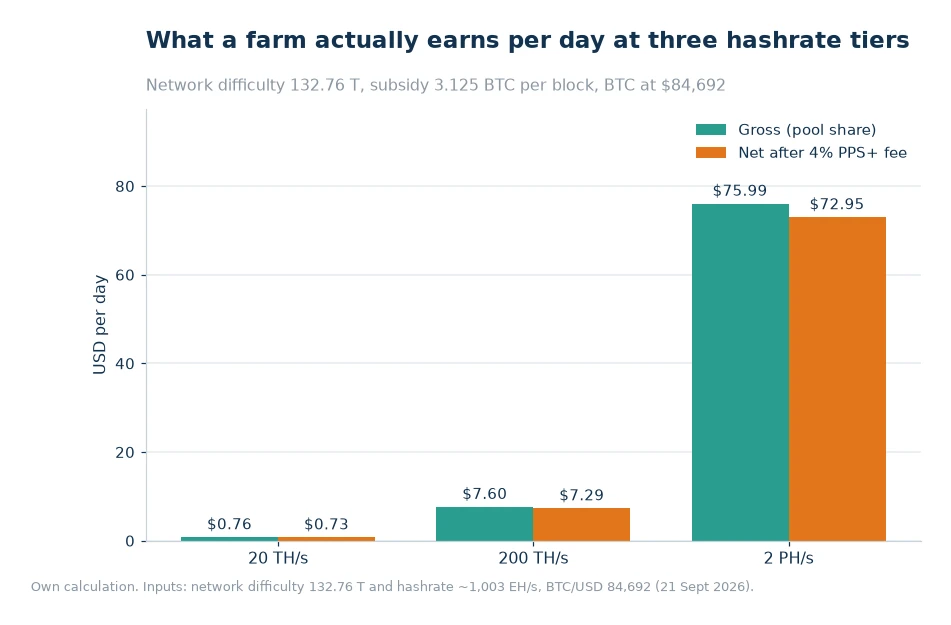
Uptime is the one pool specification that costs you money in silence, because a machine that is disconnected earns exactly nothing. A 200 TH/s rig that would have produced about 0.0000897 BTC a day — $7.60 gross at $84,692, or $7.29 after the listed 4% fee on the block-reward component — loses $22.80 a month if it simply sits idle for three days. That is more than any fee comparison will ever hand back, which is why the uptime question comes first.

Key takeaways
- Downtime is priced in whole units of output: at $7.60 gross a day for 200 TH/s, three idle days cost about $22.80 — far more than the gap between a listed 4% and 2% fee on the same rig.
- Two variables decide what uptime is worth to you: how fast a failed worker is noticed and fixed, and how consistently the pool's share of network hashrate holds up.
- Settlement cadence is part of the record too. PPS+ pays hourly against current difficulty; PPLNS distributes after six confirmations across the last five difficulty rounds, so a longer feedback loop hides problems longer.
- Check published pool statistics, per-worker hashrate and pool hashrate yourself, and set alerts. A pool that serves miners in 150+ countries with over a million users will publish numbers you can compare month to month.
Context in 2026
Pool comparison has become a fee-page exercise, and that is a mistake. Fees are published, comparable and small; uptime is undocumented, invisible and large. At today's difficulty of 132.76 T and a network hashrate near 1,003 EH/s, a 2 PH/s farm produces roughly 0.000897 BTC a day — about $75.99 gross and $72.95 after the listed block-reward fee. A day and a half of unplanned downtime costs that farm more than a year of fee difference between the two published payout methods.
There is also a structural reason to care about pool health rather than your own dashboard alone. A pool's ability to pay on time depends on its share of network hashrate staying stable, its block-finding rate staying near expectation, and its infrastructure staying reachable from wherever your machines sit. None of those appear in a fee table.
The two variables that matter
Time to detect and time to fix
Every minute between a worker going offline and somebody noticing is lost output at full price. The measurable version of this is how granular your monitoring is: per-worker hashrate, a mobile alert when a board drops, and a dashboard that distinguishes a dropped worker from a pool-side reporting gap. Mobile apps that push real-time hashrate alerts and support several accounts on one login are what make the detection window minutes rather than days.
Consistency of the pool's own output
A pool that finds blocks at its expected rate is a pool whose payout method behaves the way its documentation says. Published pool hashrate, network hashrate, difficulty and miner counts are the raw material for that judgement, and they are worth checking monthly — not because a bad reading means failure, but because a shrinking share explains a run of smaller payouts before you start suspecting your own hardware.
| Check | Where to find it | Signal to watch |
|---|---|---|
| Payout cadence | Pricing and payout documentation | Hourly settlement (PPS+) keeps the feedback loop short; PPLNS waits for six confirmations |
| Fee per component | Pricing page | A listed 4% on the block-reward component and 2% on transaction fees is not a 6% total |
| Node coverage and latency | Pool documentation, your own ping tests | Stale share rates and rejects rise with distance from the nearest stratum endpoint |
| Worker-level visibility | Pool dashboard | Per-worker hashrate curves and alerts shorten the detect-to-fix gap |
| Pool hashrate trend | Pool statistics | A falling share of network hashrate lowers everyone's payout frequency |
| Payout rail | Wallet documentation | Zero-fee mining payouts and in-account conversion remove transfer steps and delays |
Numbers from a real rig
Put figures on both variables, using a single 20 TH/s machine as the small end of the range. At current difficulty it earns about 0.00000897 BTC a day, which is $0.76 gross and $0.73 after the listed block-reward fee. A week offline therefore costs roughly $5.11 — small in absolute terms, but it is the entire margin on a machine whose electricity and hosting costs continue regardless.
Scale the same logic up to a 2 PH/s operation and the numbers force the decision. Gross daily output is about $75.99. A pool that delivers hourly settlement turns that into roughly $3.17 an hour arriving in the account, which means a failure is visible in the cash flow quickly and a rushed hardware repair can be funded from income rather than from reserves. A pool on a longer settlement cycle leaves the same farm waiting and, worse, hides a connectivity fault behind its own reporting lag.
Then price the fee question honestly. The difference between a listed 4% and a listed 2% on a $7.60 day is about $0.15 — call it $4.56 a month on a 200 TH/s machine. Three days of downtime on the same machine is $22.80. If you have to choose where to spend your attention, spend it on the uptime question, and read the published fee documentation carefully enough to know which component each percentage touches.[1][2]
Decision guide
- Start with the payout rail. Zero-fee mining payouts into a built-in multi-currency wallet remove a monthly fee event and a transfer delay at the same time.
- Check the cadence against your cash flow. If electricity and hosting are monthly, a payout cycle measured in hours removes the need to bridge the gap from reserves.
- Verify what the pool publishes. Pool hashrate, network hashrate, difficulty and miner counts are public; treat a shrinking share as a cost, not a curiosity.
- Test latency before you commit hardware. Connecting from your region to the nearest endpoint and watching stale-share rates for a week costs nothing and tells you more than a specification page.
- Set worker alerts on day one. The value of monitoring is proportional to how much output an unnoticed failure destroys.
- Look at the operating record, not the interface. ViaBTC Crypto Mining reports serving miners in 150+ countries with more than a million users and publishes monthly pool statistics you can track on the mining pool dashboard.
Frequently asked questions
Is a bigger pool always better?
Size reduces payout variance but also concentrates hashrate. What matters more is fee structure, uptime, latency and payout cadence.
What happens if my miner goes offline?
Shares stop, so expected income stops with them. Alerts and a dashboard that shows per-worker hashrate shorten the gap between a failure and a fix.
How do I judge a pool's uptime if the pool does not publish an uptime percentage?
Use proxies you can measure yourself: per-worker hashrate history, how quickly payout settlement lands against the documented cadence, and whether pool hashrate tracks network hashrate over several weeks.
What to do before you point hashrate anywhere
Write down today's date, your rig's expected daily output at current difficulty, and the settlement cadence the pool documents. Check both again in thirty days: if the cadence slipped or the pool's share of network hashrate fell, you will see it in your own numbers rather than in a marketing claim. The comparison that finally matters is between your measured output and your calculated expectation — and that comparison is only possible if you keep the baseline.
Data and sources: ViaBTC pricing page[1] and fee breakdown article[2], with network difficulty, hashrate and BTC price read from public chain data and market feeds on 21 September 2026. Figures are illustrative; difficulty and price change. Read on 21 September 2026.